From the start, I knew I wanted to specialize in power electronics, and the graduate scheme equipped me well for this role. Thanks to the scheme, I entered my chosen role with nearly two years of experience working with 500kW drive systems and designing a four-quadrant drive, which was a completely new product for the company at the time.
The learning did not stop after completing the graduate scheme. Although the rotation phase ended, I continued to grow and develop into a specialist in power electronics, my chosen field. The company and mentors provided ongoing support, challenging me and encouraging to work towards chartership.
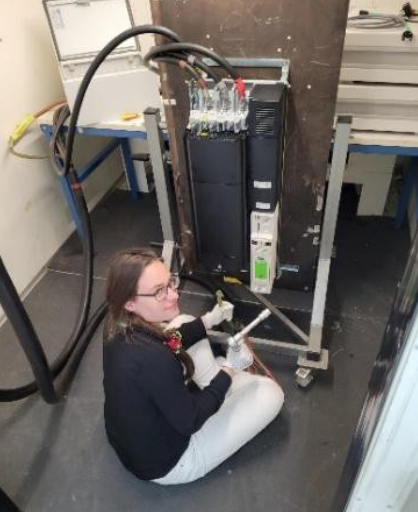
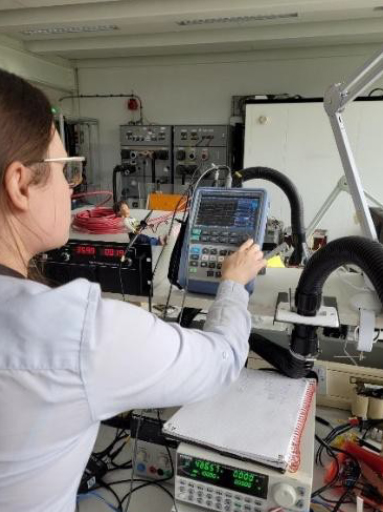
After finishing the graduate scheme, I continued working on the development of a regenerative, four quadrant drive. This project involved PCB design, assisting manufacturing during production, and testing prototypes. Once the project was completed and the customer was satisfied with the prototype, I moved on to a new project with increased responsibilities.
I became the electrical lead on one of the new drive frames, and I am making sure mechanical, electrical and manufacturing side of the project are all working with each other to deliver first prototype of the new product.
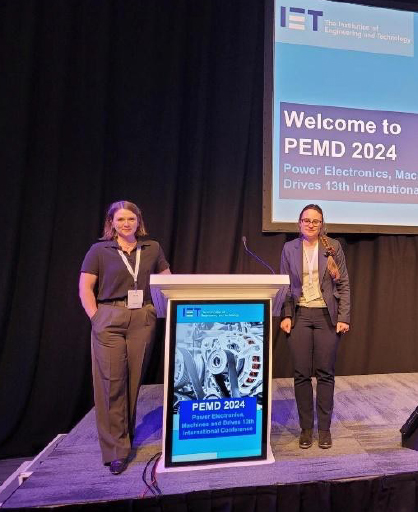
Nidec Drives has continued to support my growth, providing opportunities to attend various training courses and conferences. In 2024, I not only attended the PEMD conference but also had the opportunity of being a speaker presenting challenges women face in the engineering industry. This experience led to my participation in discussions about the latest developments in power electronics and helped me establish valuable connections within the industry. As a result, I was invited to join the organizing committee for the 2025 conference in Turin, Italy.
I studied for an MEng in Electrical and Electronic Engineering at Newcastle University and graduated in 2022. Throughout my time at university, I completed varied summer placements in different teams within R&D, but after joining full time I still wasn’t sure which area I wanted to focus in. The graduate scheme at Nidec Drives really helped as it allowed me to rotate through different areas and I was fortunate to be able to experience such a wide range of departments.
My first graduate placement was in R&D power electronics, where I tested various PFC IGBT controllers as part of a feasibility investigation for a new product. This allowed me to build on what I had learnt at university and take it further, not just limiting to circuit simulation with software but following it through to prototyping the boards, conducting functional and EMC testing, and finishing with discrete component cost comparisons and integration into current product design.
The second rotation took me to the UK manufacturing site with the test development team, where I gained experience within Process and Manufacturing Engineering, an area I didn’t have any experience in before. Working within the factory environment gave me an important insight into the different test processes for our products at various stages of production. As a test development engineer my projects involved test software reviews to optimize test time, conditions, and coverage, as well as prototyping new drive test methods. Getting involved as a process engineer in a cross functional team allowed me to see how a project is managed between different engineering teams and helped me expand my network within the company, creating more meaningful working relationships from people from even more departments.
I returned to R&D for my third placement within Mechanical Engineering. Here, I was involved in the design and prototyping of new test and production fixtures, component stress testing, product thermal simulations, and production part approvals. A highlight for me was following through the complete process for introducing a new product casing, starting from initial customer request and CAD design through to supplier sample verification and end product release. This placement was interesting and challenging as it was different to what I studied at university, but I had incredible support from my supervisor and colleagues throughout, which helped me gain my footing quickly. Thanks to them, although I was doing a lot more learning and training than if I was in a department I had more experience in, I was still contributing to the active development of new products at the same time.
My final placement took me back to the factory where I worked in the Quality Engineering department. My work there involved collaboration with the New Product Development team to apply the lessons learnt from failures seen in the field to new designs, thereby improving the current manufacturing process. I really enjoyed this as it helped me see the design considerations from many other engineering perspectives and how they all link together to solve the same problems. Investigating the field failures also gave me a valuable insight into our end customers’ applications and experiences, something that is easy to be distanced from when focusing on specific details within R&D.
Overall, my graduate scheme was extremely positive because it gave me experience across a wider variety of engineering development departments than if I had focused solely on electrical engineering. In addition to improving my technical skills, the different roles and levels of responsibility have been great for helping me move towards a chartership qualification in the future.
I graduated with an MEng in Electrical Engineering from the University of Nottingham in 2022, having been supported financially and professionally by Nidec Drives throughout my degree via the E3 Academy. After graduating I was part of a wide range of engaging and rewarding projects in the graduate scheme.
My first placement was in electromagnetic compatibility (EMC). The purpose of EMC is to ensure electrical equipment functions correctly whilst in the presence of other electrical equipment. This is important because all electric circuits produce undesired electrical ‘noise’ that could cause nearby circuits to behave unpredictably. I was responsible for testing products to international standards, taking measurements and checking for any unusual behaviour. If the test failed, I tweaked the design to increase resilience to electrical noise. EMC is a particularly understudied area of electrical and electronic engineering at universities so being introduced to the topic at Nidec Drives has provided me with a valuable skill in high demand.
In power electronics I applied my theoretical knowledge from university to pulse testing, where the electrical losses of IGBTs (electrical switches that are used to convert direct current to alternating current) are measured. This information is used to predict how hot drives will get when they are operating, ensuring that they are reliable and safe. I also investigated different thermal interface materials to determine which was best able to transfer heat from IGBTs to heatsinks, while considering a range other factors, namely cost and manufacturability.
Equipped with experience in EMC and power electronics, I attended a course in Cambridge on designing power electronics with EMC in mind. This was a great way to cement my understanding, applying it to situations I hadn’t considered. I also networked with engineers and academics from across the world, each with their own expertise and challenges to solve. I have since applied the skills gained from this experience to consider EMC in electrical circuits throughout the design process.
I then had an opportunity to work on switch mode power supplies. This was another area I studied at university, although I didn’t have much practical experience in it. A highlight was redesigning the control system on a power supply to better respond to short term disturbances. I simulated the system in software, implemented it, and measured how well it performed in reality. This was a complex problem to solve but was very rewarding when the simulation matched the measurements and to think about the tens of thousands of drives that will be built with my design!
Finally I joined technical support where I helped diagnose customer problems from the field. Sometimes these problems demonstrated ways the original design could be improved which I was able to test and implement. This was a great opportunity to consider design from a user’s perspective, understanding ways that decisions can impact customers in unexpected ways.
Overall the graduate scheme at Nidec Drives has allowed me to work with and learn from accomplished engineers across the company and has equipped me with a diverse skillset that I now deploy as a development engineer in the power team.
